The Blind Canadian is the flagship publication of the Canadian Federation of the Blind (CFB). It covers the events and activities of the CFB, addresses the issues we face as blind people, and highlights our members. The Blind Canadian:
• Offers a positive perspective and philosophy on blindness
• Serves as a vehicle for advocacy and protection of human rights
• Addresses social concerns affecting the blind
• Discusses issues related to employment, education, legislation and rehabilitation
• Gives an overwiew of the Canadian blindness scene
• Provides news about products and technology used by the blind
• Tells the stories of blind people
• Covers convention reports, speeches, experiences
• Archives historical documents
EDITOR: Doris Belusic
PREPRESS, PROOFREADING & WEB DESIGN: Sam Margolis
The Blind Canadian, published by the Canadian Federation of the Blind, comes out in print and on www.cfb.ca in web and pdf versions
The Blind Canadian welcomes articles, resources and letters to the editor for possible publication.
Canadian Federation of the Blind
Douglas Lawlor, President
PO Box 8007
Victoria, BC, V8W 3R7
Phone: (250) 598-7154 Toll Free: 1-800-619-8789
Email: editor@cfb.ca or info@cfb.ca
Website: www.cfb.ca
Find us on Facebook
Twitter: @cfbdotca
YouTube channel: https://www.youtube.com/user/CFBdotCA
FEATURED ARTICLE: Structured Discovery
Blindness Rehabilitation in Canada:
An Interpretive Analysis
By Elizabeth Lalonde, MA
Editor’s note: Elizabeth is director of The Pacific Training Centre for the Blind in Victoria, BC. She trained for nine months at the Louisiana Center for the Blind, an NFB-affiliated training centre in Ruston, Louisiana. Elizabeth is a past president of the Canadian Federation of the Blind, having held this position for almost a decade. Thank you, Elizabeth, for writing your 111-page brilliant master’s thesis on the important subject of structured discovery and bringing knowledge of it to the attention of Canadian academia and Canadian society.
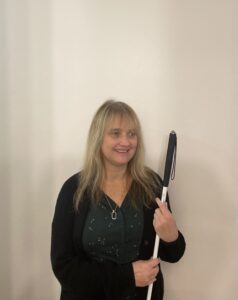
Blindness rehabilitation in Canada has long been shaped by medicalized and custodial approaches that emphasize adjustment to vision loss rather than independence, problem-solving, and confidence-building. While alternative models exist, there has been little academic research examining empowerment-based approaches within the Canadian context. My master’s thesis, An Interpretive Analysis of the Effectiveness of Structured Discovery Blindness Rehabilitation in Canada, seeks to address this gap by examining how blind Canadians experience Structured Discovery training and what this model can contribute to rehabilitation policy and practice in Canada. This article summarizes the purpose, methodology, key findings, and implications of that research.
Research Purpose and Questions
The purpose of this study was to explore how blind people in Canada understand and experience Structured Discovery blindness rehabilitation, both as students and as teachers. Structured Discovery is an experiential, problem-solving approach to learning non-visual skills that emphasizes confidence, independence, and blind leadership.
Four research questions guided the study:
1. How do blind people in Canada describe their experiences with Structured Discovery training?
2. How do participants compare Structured Discovery with traditional rehabilitation services they have received or observed?
3. What skills, perspectives, or capacities do participants feel they developed through Structured Discovery training?
4. What challenges or limitations do participants identify within the Structured Discovery model?
Together, these questions allowed for a nuanced exploration of both the strengths and the complexities of the model.
The Problem
In the Canadian Context, the central problem addressed by this research is the lack of Canadian evidence on Structured Discovery. Prior to this study, no academic research examined the model from the perspective of blind Canadians. Existing literature on blindness rehabilitation in Canada largely reflects medical or custodial orientations that focus on adapting to vision loss rather than developing transferable problem-solving skills and independence.
This absence of research has real consequences. Without Canadian evidence, policymakers, funders, and rehabilitation professionals have limited guidance on the value of empowerment-based models. As a result, many blind Canadians continue to face barriers to employment, education, and full participation in community life, despite decades of rehabilitation services.
Conceptual Framework: Critical Disability Theory
This study is grounded in Critical Disability Theory, which challenges deficit-based and medicalized understandings of disability. Rather than framing disability as an individual problem, this framework emphasizes social, political, and cultural structures that shape disabled people’s lives, along with agency, capability, and collective empowerment.
Critical Disability Theory is particularly relevant to blindness rehabilitation because rehabilitation models can either reinforce dependency or promote independence. Traditional custodial approaches often position blind people as passive recipients of care. In contrast, Structured Discovery treats blind people as capable, resourceful problem-solvers who can learn, adapt, and lead.
Literature Review and Research Gap
The literature informing this study spans three main rehabilitation approaches: traditional vision rehabilitation, functional or guided learning models, and Structured Discovery.
Traditional vision rehabilitation literature in Canada frequently reflects a medical or custodial orientation, emphasizing adjustment to vision loss and professional oversight. Functional or guided learning models focus on teaching specific tasks step-by-step. While useful in some contexts, this approach is often criticized for limiting experimentation, confidence-building, and transferable problem-solving.
The Structured Discovery literature, largely originating in the United States, highlights experiential learning, real-world problem-solving, blind instructors as role models, and the development of confidence and non-visual skills. However, in Canada, this literature consists primarily of grey material rather than peer-reviewed research.
Together, these bodies of literature reveal a clear gap: there has been no academic study of Structured Discovery in the Canadian context, reinforcing the need for this research.
Methodology: Interpretative Phenomenological Analysis
This study used Interpretative Phenomenological Analysis (IPA), a qualitative methodology focused on understanding how people make meaning of significant lived experiences. IPA was well-suited to this research because the study centered on how blind Canadians interpret their experiences with Structured Discovery training.
I recruited 10 participants using purposive sampling to ensure direct experience with the model as students or teachers. I conducted semi-structured interviews over Zoom, each lasting approximately 60 minutes. This format allowed participants to share rich personal narratives while addressing topics relevant to the research questions.
My analysis followed IPA’s six-step process, emphasizing careful engagement with each participant’s account before identifying shared themes. I included a positionality statement to acknowledge my role as a blind researcher with Structured Discovery training. I used ongoing reflexivity to ensure that participant voices remained central to the analysis.
Key Findings
Eight interconnected themes emerged from the data.
Empowerment and Accomplishments
Participants consistently described Structured Discovery as transformative. One participant, Chris, reflected, “I became a more confident and competent blind person. I didn’t realize how much I would learn—it was truly life-changing.” Empowerment emerged through hands-on challenges, self-trust, and the realization of personal capability. These accomplishments were not merely task-based but deeply personal, reshaping how participants saw themselves as blind people.
Problem-Solving and Exploration
Participants emphasized learning through exploration rather than instruction. As Chris explained, Structured Discovery may take longer initially, but it enables far greater long-term outcomes. This approach helped participants develop adaptable problem-solving skills, allowing them to navigate unfamiliar environments and changing situations with confidence.
Role Modelling, Mentoring, and Lived Experience
Blind instructors played a crucial role. Vince captured this when he stated, “This is our experience and our lives—we do this every day.” Participants described blind instructors as credible, authentic, and deeply understanding. Mentorship extended beyond skills instruction, demonstrating possibility and reshaping beliefs about blindness.
Self-Advocacy and Agency
Structured Discovery supported participants in developing a stronger voice and sense of agency. Julie described confidently explaining her abilities in employment contexts rather than accepting doubt from others. Participants reported greater assertiveness, comfort advocating for non-visual techniques, and confidence presenting themselves in public, educational, and workplace settings.
Importance of Learning Non-Visual Skills
Participants described non-visual skills as foundational rather than compensatory. Silvia explained choosing non-visual methods even when she could rely on vision, reflecting a deeper trust in her abilities. Participants emphasized that these skills provided reassurance and preparedness for future vision changes.
Issues with Traditional Rehabilitation
Many participants contrasted Structured Discovery with traditional rehabilitation, which they described as prescriptive and route-based. Julie noted that traditional approaches often build dependence rather than transferable skills. Participants also highlighted long waitlists, limited instruction hours, and an emphasis on maximizing residual vision over adaptability.
Challenges with the Structured Discovery Model
Participants acknowledged challenges, particularly the shortage of trained instructors and chronic underfunding. Low pay and limited training pathways make recruitment and retention difficult. Some participants also described the training as physically and emotionally demanding, particularly early on, though most viewed these challenges as part of the growth process.
Providing a Canadian Context
Participants emphasized that Structured Discovery is not widely available in Canada. Many had accessed training in the United States due to the dominance of CNIB-affiliated programs domestically. Funding instability, lack of government support, and geographic inequities were identified as major barriers to access, raising significant equity concerns.
Recommendations and Conclusion
Based on these findings, several recommendations emerge. There is a clear need to expand access to Structured Discovery programs in Canada and to develop and support blind instructors through sustainable training pathways. Greater institutional recognition and stable funding are essential to ensure long-term viability. Rehabilitation policy must explicitly incorporate non-visual skills, experiential learning, and problem-solving as core components of effective blindness rehabilitation.
This research provides the first Canadian academic evidence that Structured Discovery is an effective and deeply empowering model. It demonstrates that blind people thrive when rehabilitation emphasizes capability, agency, and lived experience. Canada must rethink disability policy and rehabilitation services and include Structured Discovery as a compelling, evidence-based alternative that deserves serious consideration.
To read Elizabeth’s 111-page thesis in full, here’s the link:
https://dspace.library.uvic.ca/items/28e4e9ee-884b-44f7-9111-9ff43af95eea
CFB Reviews & Accolades on Elizabeth’s Thesis
“Dear Elizabeth,
“Thank you kindly for sharing the link to your thesis for your master’s degree. I can be a slow reader at times, but I was determined to make my way through the 111 pages that you worked so hard on. It took me almost 4 hours to read, but I now have a good understanding of structured discovery and how it promotes independence. To quote you: “structured discovery redefines blindness”. This paper is a beautiful piece of work and I admire your thoroughness. You made me understand that structured discovery is not only about real growth by deeply empowering people, but I especially liked your comment about how it helps to dismantle “internalized oppression”. The implications of that large and powerful statement stopped me in my tracks.
“In addition to learning about structured discovery, I appreciated your scan of the broad systemic issues that profile large problems that exist in our Canadian model. You so beautifully suggest, we need a “reimagining of blindness in Canada”, and I think your work goes a long way to setting the stage for more discussion and action. Congratulations, Elizabeth!”
~ Thelma Fayle
“Elizabeth, excellent work on your thesis. I hate that kind of writing, but I couldn’t put the thesis down. I finished it in one sitting.
“I hope a copy of this is sent to every relevant legislative committee in British Columbia and throughout Canada. It particularly needs to reach provincial employees who are in charge of contracting services. The “one size fits all“ CNIB monopoly needs to end. Finally, we have an academic framework for suggesting it. We’ve (CFB and NFB) always had a strong philosophical basis, but it’s good to have resources that come from another direction and say the same thing.”
~ Mary Ellen Gabias, CFB treasurer, past president
Going Back to School: Reflections on Completing a Master’s Degree as a Blind Woman
By Elizabeth Lalonde
Editor’s note: Huge congratulations, Elizabeth!
Going back to school had always been a dream of mine. For years, I assumed it would remain just that—a dream. Life, work, family, and responsibility filled every available space. I also carried the quiet belief that I might simply be too old to return to university. At forty-nine, graduate school felt like something meant for other people, earlier in life.
Eventually, I decided to do it anyway.
I enrolled in the Master’s in Community Development through the School of Public Administration at the University of Victoria and was chosen to take the program. I was forty-nine when I started, and it took me three years to complete the degree. I did not return to school to change direction or reinvent myself. I returned because learning always mattered to me, and because I wanted the chance to pursue something I postponed for far too long.
Graduate School as a Blind Student
Blindness was not a barrier in my graduate studies. From the beginning, my experience was welcoming, respectful, and supportive. Faculty members were open and accommodating. They handled accessibility collaboratively and without resistance. I received course materials in formats I could access. I felt included in discussions, and people expected as much of me as anyone else.
People treated me as a graduate student first. They understood my blindness as part of who I am, and did not frame it as an obstacle to my success. That experience is worth naming, because blind people often receive messages—directly or indirectly—that higher education will be difficult or inaccessible. My experience at the University of Victoria challenged that assumption in a very real way.
Choosing Community Development
The Master’s in Community Development was a natural fit. Community development centres participation, power, and lived experience. It asks who gets to define problems and whose voices are taken seriously. Those questions shaped my work for decades as a blind advocate, educator, and organizational leader.
This program gave me a language for work I was already doing and a framework for examining it more deeply. Instructors encouraged me to draw on my experience, to think critically, and to engage with theory in ways that felt grounded rather than abstract. Graduate school became a space where my professional background and my identity as a blind person strengthened the academic work rather than competing with it.
My Thesis
My thesis focused on Structured Discovery, an empowerment-based model of blindness rehabilitation that emphasizes problem-solving, non-visual skill development, and learning through real-world experience. Structured Discovery is typically taught by blind instructors and is grounded in the belief that blindness, when approached with the right skills and expectations, does not limit a person’s ability to live independently and fully.
My research examined the effectiveness of Structured Discovery in Canada from the perspectives of blind service recipients and teachers. Using qualitative methods, I explored how participants experienced this approach, how it shaped their confidence and independence, and how it differed from more traditional rehabilitation models that continue to dominate service provision.
This work mattered to me personally and professionally. I have seen firsthand how empowerment-based training changes lives. I wanted my thesis to reflect blind people’s own voices and experiences, and to contribute research that could support stronger policy, funding, and recognition of non-traditional approaches to blindness rehabilitation in Canada.
Researching as a Blind Scholar
Conducting this research as a blind scholar felt both natural and important. I was researching within my own community, guided by relationships, trust, and accountability. My positionality informed the questions I asked and the care I took in representing participants’ experiences.
Graduate school gave me tools to analyze and communicate what blind people have long known about the value of high expectations, peer role-models, and meaningful skill development. It strengthened my ability to connect community knowledge with academic and policy conversations.
What the Degree Has Meant
Completing my Master’s degree expanded my confidence in academic, professional, and policy spaces. It strengthened my advocacy work and deepened my understanding of systems that affect blind people’s lives. The degree supports the work I continue to do in blind-led training and education, and it gives added weight to arguments grounded in lived experience.
Perhaps most importantly, returning to school reaffirmed something I already believed: learning does not belong to any one age group, and blind people belong fully in higher education.
Moving Forward
This degree represents the fulfillment of a long-held dream. It also represents a continuation of work that matters deeply to me—supporting blind leadership, advancing empowerment-based approaches to blindness, and contributing research that reflects the realities of our lives.
I went back to school at forty-nine because the timing finally felt right. Three years later, I am grateful that I gave myself permission to try.
Story of Staying Calm During Interaction at the Bus Stop
By Blaine Deutscher
(Includes “The Courtesy Rules of Blindness”)
I’ve often heard people mention the “spoons” it takes to live with a disability. As we know, perceptions are what create the barriers when it comes to blindness. I strongly agree with the statement from the U.S. National Federation of the Blind (NFB): “Live the life you want” and also that “Blindness isn’t the characteristic that defines you.” It can be a real struggle at times though.
One thing I strongly recommend to any newly blind person, or anyone struggling with their sense of worth, is to go to an NFB national convention – a week where blindness is “cool” and accepted – a place where you can be yourself, grow alongside your fellow blind people.
I really had to test my spoons the other day while waiting for a bus. A person came up to me and engaged in conversation about my guide dog. The usual comment, “You have such a nice dog.” I obviously thanked him, then he proceeded to tell me how sorry he felt for me. I asked him why, and he said that it was due to my blindness. I reminded him about the blessings of being blind: I don’t have to see all the horrible things that happen in the world. He continued to feel sorry for me. I continued asking why. He couldn’t get past the fact that I couldn’t see. He asked if I lived alone, in which I proudly mentioned I am now married but I had lived alone for about 20 years. I do everything in a home that everyone else does, including mowing my yard. He did the usual, “That’s amazing.” I reassured him that amazing was doing something that takes a lot of determination and endurance, like mountain climbing or going to run your first marathon – not stepping outside your door and going for a walk.
Playing devil’s advocate a little, I can see how people would find this “inspiring” though. With only about 8% of blind people being fully blind, sight is the most used, most dominant sense of all our five senses. People can foresee going without hearing, smell or taste, but sight???
We, as blind people, need to work on educating the public about what we can do. I’ve heard so many blind people complain about the lack of society’s understanding – and this comes with family, too – but we need to jump in and help educate.
I recently listened to the National Federation of the Blind’s podcast, “Nation’s Blind” where the hosts were discussing the holidays they had with family. Some family just don’t get what we are able to do. If you’re dealing with a 90-year-old aunt who insists on guiding you to the bathroom, what harm is it going to do, so that it makes her day? You can still set boundaries, but having them take you to a restroom is okay; a child also might want to help is okay, but you can turn that into an educational piece.
Many blind people complain about how family plays board games and don’t include you. If you know your family is one that plays games, perhaps purchase some brailled game, or get yourself a deck of braille cards. This way, when people want to play a game, you can offer a few options. Many people may not even know about what kind of braille games are out there, especially if they don’t see you that often.
One of the podcast guests mentioned he has a chore that he quite likes and he just jumps in and does it – his is doing the dishes.
In saying all this, it is easy to get discouraged, but don’t give up hope.
If you’re a newly blind person, know the definition of blindness from NFB: https://nfb.org/sites/default/files/images/nfb/publications/fr/fr19/fr05si03.htm
We, at the Canadian Federation of the Blind (CFB), are here to support you, walk alongside you, and believe in you. If you’re reading this and never have come across a blind person, here is a list of steps that will make everyone’s life a little easier. The biggest take-away is to always ask a blind person because, with blindness being a spectrum, what works for one person may not work for another.
THE COURTESY RULES OF BLINDNESS (from nfb.org)
When you meet me, don’t be ill at ease. It will help us both if you remember these simple points of courtesy:
1. I’m an ordinary person, just blind. You don’t need to raise your voice or address me as if I were a child. Don’t ask my spouse what I want—”Cream in the coffee?”—ask me.
2. If I am walking with you, don’t grab my arm; let me take yours. I’ll keep a half-step behind, to anticipate curbs and steps.
3. I want to know who’s in the room with me. Speak when you enter. Introduce me to the others. Include children, and tell me if there’s a cat or a dog. Guide my hand to a chair.
4. The door to a room, a cabinet, or a car, left partially open, is a hazard to me. Note: You don’t have to run over and apologize though. A simple mention like “I’m sorry the cupboard door is open” or “I left the drawer open in the bathroom.” This is where using a cane in an unfamiliar area helps. Listening to your surroundings helps, too. Accidents will happen, so if you’re walking quickly through someone’s house and a door is open, you might run into it, just like a sighted person running through a house chasing someone, may not realize the door is open – or may back up into something.
5. At dinner, I will not have trouble with ordinary table skills.
6. Don’t avoid words like “see”. I use them, too. I’m always glad to see you.
7. I don’t want pity. But don’t talk about the “wonderful compensations” of blindness – my sense of smell, touch and hearing did not improve when I became blind. I rely on them more, and therefore may get more information through those senses than you do—that’s all.
8. If I’m your houseguest, show me the bathroom, closet, dresser, window—the light switch, too. I like to know whether the lights are on.
9. I’ll discuss blindness with you if you’re curious, but it’s an old story to me. I have many other interests as you do.
10. Don’t think of me as just a blind person. I’m a person who happens to be blind.
I Am Blind Book Featured in Greater Victoria Public Library’s Emerging Local Authors Collection and Celebration
By Doris Belusic
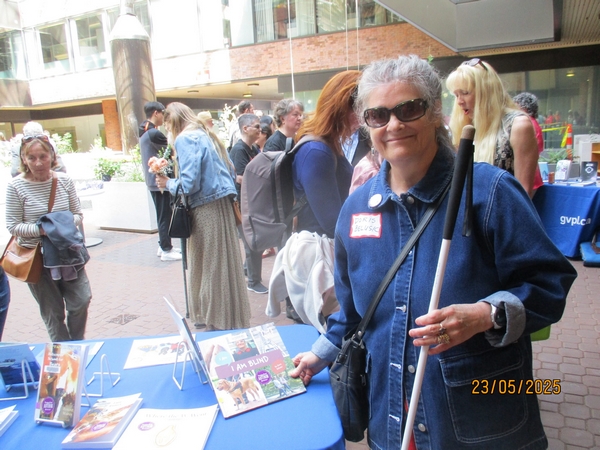
The Greater Victoria Public Library held its annual celebration of emerging local authors who have recently had books published. This celebration took place on May 24, 2025, in the sunshine on the large, beautiful outdoor front patio of Victoria’s Broughton Street main library branch. I and my book, I Am Blind (Beech Street Books, 2024) were celebrated, along with over 100 other emerging local authors and their books. These books are in a special collection and are on display at the main Victoria branch for one year.
It was a fun event, and I am grateful that my friend, Thelma Fayle, who received this same honour some years earlier for her book, Ted Grant: Sixty Years of Legendary Photojournalism (Heritage House), accompanied me. We were treated to a canned drink, delicious Dutch Bakery cookies, photography, emerging author buttons and pens; we listened to several speeches and checked out some of the other books on display. The library put on a beautiful event.
Meet Glide: The Future of Independent
Mobility for the Blind (!?)
Editor’s note: NBC’s Today Show featured Glide as a top CES 2025 pick. (CES is the huge, annual Las Vegas Computer Electronics Show.) And those attending the 2025 U.S. National Federation of the Blind (NFB) convention got to trial this device. The Glidance company is based in Seattle, Washinton. Glide is still in testing phase and not yet in full final production, but an initial consumer version is said to be available in Spring 2026. The information below is compiled from the Glidance website, www.glidance.io. They say to share information widely.
By blending intuitive design with cutting-edge navigational robotics and AI, Glide will take you where you need to go comfortably, safely and independently.
Glide is the world’s first autonomous, intelligent mobility and navigation assistive device for people who are blind or have low vision. This will be an alternative to the white cane and guide dog travel options.
Hold Glide’s ergonomic handle in one hand in front of you and walk at your own pace. Glide will simply guide you by steering its wheels and braking.
Glide is light, intuitive, and built for real-world environments. With two 7.5-inch rugged, all-terrain wheels connected to the ground and an adjustable telescoping handle, Glide physically guides you through familiar and unfamiliar environments; from unpaved sidewalks and streets to a stroll through the park to busy shopping malls and high-traffic airports. Simply nudge the device forward in front of you, and let Glide steer the way. Purpose-built for blind and low vision mobility, Glide gives you the freedom to navigate while avoiding obstacles.
Some of Glide’s Capabilities
• Smart Indoor & Outdoor Navigation – Walk with ease and without veering, whether on a familiar route or following guided directions.
• Locate Doors, Elevators, Stairs, & More – Glide finds key targets and steers you towards them, taking you those last few feet to your destination. With its camera and sensors, Glide will detect and direct you to key waypoints and line-of-sight targets, applying haptic feedback, audio alerts, and automatic braking when you arrive.
• Navigate Intersections & Road Crossings – Identify crosswalks and stay on target without veering until you reach the other side.
• Line Maintenance & Obstacle Avoidance – Maintain a purposeful line while navigating around stationary or moving obstacles and hazards – from small drops to overhead branches and signs.
• Stay Informed, Not Overwhelmed – Intuitive tactile haptic and audio cues keep you in the flow and aware of what’s around you – without all the noise.
• Gets Smarter Over Time – With regular software improvements, over-the-air updates, and continuously improving AI models with usage, Glide gets smarter over time.
• Easy to learn – Simply start walking and let Glide intelligently steer the way. Its intuitive design ensures a smooth and effortless experience, allowing you to focus on the journey, not the obstacles.
• At your own pace – Gently push Glide forward at your own pace. Glide keeps you on a safe path, while providing real-time information about your surroundings, ensuring you stay aware and informed.
• Rugged & light – Glide is crafted to be both elegant and highly resilient. Weighing less than 8 lbs, it can withstand whatever your day throws at it – bumps, bangs, rain and more.
• Pre-mapped and freestyle walking – Pre-program your most frequent routes, or simply start walking without a set destination in mind. Glide gives you the freedom to move on your own terms.
Technical Features
• Telescoping handle with comfortable grip, with target height of 25 inches when fully compacted
• Directional haptic feedback in the handle
• Built-in speaker, microphones and Bluetooth connection for audio feedback
• Selection buttons and a programmable “quick access” button in the handle
• 7.5-inch replaceable all-terrain wheels with intelligent steering, power assist and dynamic brakes
• Stereo depth camera with 50-feet range, and near-range sensors for obstacle and cliff detection
• Rechargeable battery for 6+ hours of active use, with smart standby mode for full-day versatility. Charge with a standard USB-C cable
• Portable, collapsable and light. Around 8 pounds in weight
Navigation Features
• Automatic steering and braking
• Path detection and guidance
• Obstacle avoidance with overhead and drop-off detection
• Primary target detection and guidance (door, crosswalk, stairs, etc.)
• Voice input
• Companion app for setup and onboarding, device settings and Over-The-Air updates
• Active scene description, guidance on pre-trained routes, map integration with 3rd party navigation apps and route planners, and 3rd party app integration coming after launch as Over-The-Air updates.
Frequently Asked Questions
When will Glide be available?
We are eager to make Glide available as soon as possible! We are currently in Beta testing, with a broader rollout to our Pioneer preorder community in the Spring of 2026.
I’m an Orientation and Mobility Specialist; How do I learn more about Glide?
Please write to us at gliders@glidance.io; we will contact you to discuss Glide training.
How long does it take to learn how to use Glide?
Glide’s intuitive design and onboarding tutorial will help you get started on your familiar routes as soon as you get the device.
Is Glide easy to use?
Yes, Glide is very easy to use; you walk, and Glide steers the way while avoiding obstacles and keeping you safe. You will quickly get a feel for its movement and learn to follow its path, steer by twisting the handle, quickly pick up speed, and gain confidence.
How long does the battery last?
Glide will run for a full day on a single charge with up to 6+ hours of active use, plus a standby mode. It can be easily charged using a standard power outlet and a standard USB-C cable.
Is Glide suitable for both blind and low vision individuals?
Glide is designed to assist anyone with limited sight to navigate outdoor and indoor environments safely and independently. That includes blind and low vision individuals, as well as people with temporary sight loss, night blindness, and other conditions.
Can Glide be used in the rain?
Glide is water resistant and can be used in rainy conditions.
How does Glide handle differences in elevation (stairs, curbs, etc)?
Glide will recognize curbs, drop-offs, and potholes, steer you safely among them while keeping you at a safe distance, and alert you with voice and haptic feedback as needed.
In the case of stairs, Glide will guide you to the beginning of a staircase and tell you when you arrive, at which point you will carry it up or down the stairs.
How do I get started with Glide?
To get started with Glide, please register below to join our Glider program or contact us for more information!
About Amos Miller, Founder and CEO
When Glidance Founder and CEO Amos Miller lost his sight in his 20s due to retinitis pigmentosa (RP) while getting his Computer Science degree, he refused to let it hold him back.
As a product executive at Microsoft Research for more than 15 years and founder of Microsoft’s Soundscape navigation app for the blind, Amos has dedicated his career to pushing the boundaries of what’s possible through technology.
Glide is Amos’ personal journey fueled by a passion for breaking barriers to independent mobility for the blind and low vision community.
For more information:
Website for Glidance: www.glidance.io
Email: gliders@glidance.io
A Dream in the Kitchen – My JenaLuca Trigger Scoop
By Doris Belusic
Making muffins is easy enough, but lately I’ve felt like I’ve needed three hands to fill muffins cups – one to scoop batter with my measuring cup, one to get the batter out of the measuring cup and into the muffin pan paper cups – and one hand to find where the muffin cups are – where the batter is to go! Consequently, getting batter into the muffin cups without making a mess has become a challenge. Sometimes I would end up with batter where I didn’t want it, including filling the same muffin cup twice. The speck of vision I have doesn’t help. Yes, three hands would have been nice. But, I only have two.
For the last several years, I have been heavily into watching YouTube cooking shows and something I learned from chefs, bakers and cooks making muffins or cookies or dishing out portions of food is that many of them use a triggered scoop. With this kitchen tool, they can scoop batter and easily trigger-drop the batter into a muffin cup or onto a cookie sheet – all with one hand.
So I decided to educate myself and check these scoops out on the internet. I learned there are many sizes, styles, materials, brands, qualities and prices. Then I came across one on amazon.ca that sounded right. It said that it is a Jumbo ice cream, muffin, cupcake and food trigger scoop. It said it is a ½ cup measure and made of stainless steel. Checking reviews, people seemed very happy with it and considered it of good quality, easy to use and to clean. The brand is JenaLuca.
Today, I made pineapple coconut muffins from leftover pineapple we had and I tried my scoop for the first time. And WOW! What a dream! No longer did I need three hands, just two – one to scoop batter and drop via trigger into the muffin cups – and my other hand was free to feel for and locate each muffin cup on the pan as I went along. WOW! No mess at all! Can I stop saying “Wow!” This is a super solution to the problem I’ve had for some years. And now it’s simple to make my muffins uniform in size.
I’ll be easily and happily making muffins from now on – thanks to YouTube, Amazon, JenaLuca – and my husband who ordered it for me! Next, I may get the 2 and 3 tablespoon cookie trigger scoops, which work in the same way.
The Origin of the Braille Cell?
By Frederick Driver
I recently read an interesting history of the telegraph. (Standage, Tom. The Victorian Internet: The Remarkable Story of the Telegraph and the Nineteenth Century’s On-line Pioneers. New York: Walker and Company, 1998; 2007.)
It began not with the cable telegraph we are all familiar with, but with its predecessor, the optical telegraph. This consisted of a number of telegraph stations along a line of sight, each visible to the next, perhaps ten miles apart, each equipped with a telescope and a large visual signaling device.
The French version by Claude Chappe was an apparently complicated apparatus of moveable arms forming a variety of angles and symbols signifying letters. The subsequent British version by George Murray, called the shutter telegraph, had a much simpler and more efficient visual signaling device, consisting of a single flat, vertical surface with a number of shutters. Each shutter could be made either open, i.e. horizontal, or closed, i.e. vertical. A shutter was visible when closed, and invisible when open.
As I was reading about this British version, I turned the page and was astounded to see (on page 15) an illustration of a shutter telegraph station, as it was in 1797. A structure marked “Officer’s Cabin”, with a small flap for a telescope, and, lo and behold, an enormous braille cell on its roof!
The cell was composed of six shutters, each openable and closable, in an arrangement exactly like our beloved braille cell.
A six-dot cell in 1797? And Louis Braille was not born until 1809.
I find this simply too extraordinary for coincidence. Louis Braille must have known of the shutter telegraph and its six-dot cell configuration.
This in no way diminishes Louis’ achievement or the greatness of his contribution. On the contrary, it underscores the brilliance and adaptability of his mind in applying an existing tool to a new context and purpose.
Standage makes no mention of braille or the blind. But he does make clear, citing a Supreme Court decision in the case of Samuel F.B. Morse and his famous Morse code, that one’s claim as an inventor is not in the least diminished by the use and adaptation of existing knowledge. [quote] “The court considered every aspect of electric telegraphy, from its earliest origins to its eventual adoption, and although it was clear that Morse’s invention had required previous inventions and discoveries by others, Chief Justice Roger Taney said this did not detract from Morse’s achievement, because nobody else had successfully fitted the pieces of the jigsaw together in the way Morse had. [skip to] The fact that Morse had received advice from others was declared to be irrelevant. ‘Neither can the inquiries he made, nor the information or advice he received from men of science in the course of his researches impair his right to the character of an inventor. [skip to] The fact that Morse sought and obtained the necessary information and counsel from the best sources, and acted upon it, neither impairs his rights as an inventor, nor detracts from his merits.” [end quote] (p. 183)
Brailleworks.com says [quote]: “[Charles] Barbier [skip to] based his ‘night writing’ system on a raised 12-dot cell; two dots wide and six dots tall. Each dot or combination of dots within the cell represented a letter or a phonetic sound. The problem with the military code was that the human fingertip could not feel all the dots with one touch.
Enter Louis Braille. [skip to] After all of Braille’s work, the code was now based on cells with only 6-dots instead of 12. [skip to] This crucial improvement meant that a fingertip could encompass the entire cell unit with one impression and move rapidly from one cell to the next.” [end quote]
But what of the illustration of a giant 6-dot cell on the roof of the shutter telegraph of 1797?
At the end of the day, the shutter telegraph is only a footnote in history, and Barbier’s 12-dot cell is history too. But Louis Braille and his beautiful alphabet revolutionized reading and writing for the blind, forever.
Vive le braille!
Healthy 26-Year-Old Man Killed By MAID For ‘Mental Illness’ – (Or, Was It Blindness?)
The Blind Canadian editor’s note: Below is an intro by CFB’s Mary Ellen Gabias:
Some of you will remember the story about the young man with diabetes who was losing his eyesight. He requested MAID and was granted it, but his mother intervened to attempt to save his life.
Although his death was postponed, he was able to find a way to accomplish his goal. He is now dead.
In one of the interviews with him, he commented that he couldn’t see well enough to access email, so email was now not something he could handle on his own. This is such a failure for our social service system. Who was there to tell him that vision loss did not mean a blighted life? Who was there to offer him hope? Apparently, nobody was there.
Now they claim that he was euthanized because of mental illness. This was not supposed to be possible until 2027, but it happened. If he had not been in the process of losing his eyesight, would the question have arisen? I wonder. We all wonder.
I am glad that CFB has taken a principled stand against MAID being used because of blindness or imminent blindness. Whatever we may believe about the process of MAID as a whole, we certainly all agree that becoming blind is not a reason to die.
Healthy 26-Year-Old Man Killed By MAID For ‘Mental Illness’
by Leah Mushet, reprinted from Western Standard News, January 9, 2026
CALGARY — A 26-year-old Ontario man has been euthanized by medical assistance in dying (MAiD) despite his doctor describing him as “young and healthy.”
Kiano Vafaeian died from MAiD on December 30, something his mother, Margaret Marsilla, announced in a Facebook post on Tuesday, stating the doctor who approved his euthanasia, found a “loophole” to kill her son.
Vafaeian received MAiD in Vancouver by a now household name in MAiD — Dr. Ellen Wiebe, referred to as “DR DEATH #2.”
Wiebe, a member of the Clinician’s Advisory Council (CAC) for Dying with Dignity Canada (DWDC), a Canadian MAiD lobbying group, and a University of British Columbia (UBC) professor, has a long history with MAiD, as she is one of the leading clinicians contributing to its administration.
Reported in 2023 by Right to Life UK, Wiebe had administered MAiD to over 400 patients, and in a video obtained by The New Atlantis, Wiebe told listeners at a conference MAiD was “the most rewarding work we’ve ever done.”
Vafaeian had previously tried to apply for MAiD in 2022 for diabetes and visual impairment.
“Four years ago, here in Ontario, we were able to stop his euthanasia and get him some help. He was alive because people stepped in when he was vulnerable and not capable of making a final, irreversible decision,” wrote Marsilla in the Facebook post.
Back in early September 2022, Marsilla found out her son had first been scheduled to euthanize himself.
According to the Free Press, Vafaeian was 23 years old at the time, he had diabetes and had lost his vision in one eye — and he had no job, girlfriend, or plan for the future.
Marsilla then learned Vafaeian had applied for MAiD for late July, scheduling his death for September 22.
Vafaeian’s doctor for MAiD was Joshua Tepper, the executive director of MAiDHouse, located in Toronto.
Tepper had written to Vafaeian by email to confirm his scheduled euthanasia:
“Hii, I am Scheduled to Die: The Rise of Canada’s Assisted Suicide Program confirming the following timing: Please arrive at 8:30 am.”
“I will ask for the nurse at 8:45 am and I will start the procedure at around 9:00 am. Procedure will be completed a few minutes after it starts.”
When Marsilla found out about the scheduled appointment by asking her daughter to access Vafaeian’s email.
Marsilla added Vafaeian had had a rough time in his life. During his childhood, Marsilla had gotten divorced from Vafaeian’s father.
On his sixteenth birthday, she had gotten him a BMW. Not long after, when Vafaeian was 17, he got in a bad car accident.
He wasn’t up for college and smoked lots of weed, while he moved quite a few times, from living with his dad to his mom, then his aunt.
According to Marsilla, he was unhappy, and once he went blind in his one eye in April 2022 — that was his tipping point.
Marsilla then posted about her son a day after finding out about his scheduled euthanasia appointment, “Can you F….. believe it!!! The doctor literlly has given him the gun to kill himself,” she wrote
Soon after, a Canadian Catholic news site, Lifesite, got hold of her post, and Tepper began getting backlash from its readers.
Tepper then contacted Marsilla, telling her that he would extend the date of her son’s death to September 28.
Five days later, Tepper texted her again saying he would not go through with killing her son, and he wanted nothing else to do with Vafaeian.
However, Vafaeian was still euthanized at the end of 2025 due to “mental illness.”
As Marsilla wrote, “This approval occurred despite euthanasia for mental illness being banned until 2027.”
“Somehow, DR DEATH #2 found a loophole in the system, one that now demands to be exposed so that no other parent has to endure this.”
Marsilla is now promising she will seek justice — so parents who also have a child with mental illness do not have to experience the same thing.
“The actions of DR ELLEN WIEBE reveal a pattern of coldness and disregard for vulnerable human life that I can no longer stay silent about… for taking peoples lives…..”
“This is not healthcare. This is a failure of ethics, accountability, and humanity.”
“No parent should ever have to bury their child because a system — and a doctor — chose death over care, help, or love,” Marsilla wrote.
CFB’s Position on MAID Regarding the Blind
The Canadian Federation of the Blind deplores any attempts by those responsible for decision-making in the Medical Assistance in Dying (MAID) program to consider impending blindness as a potential reason to end a life. In the case of blind individuals, employing MAID is a stark example of the common, and tragic, misunderstanding of blindness and its consequences. Adjustment to blindness is difficult, and blind people face their own particular challenges, but it is well known that these challenges can be met, and the technology and services available today have vastly improved prospects for the blind. That someone facing blindness might want to die is tragic; that the state might sanction and aid the suicide of blind people is a total betrayal of trust and decency. The Canadian Federation of the Blind invites any blind person or their supporters to connect through our email group or our contact form, and we will be here to support. We also stand willing to actively oppose this program and its devastating ramifications for the blind.
Uber Called Out By Service Dog Users Who Are Fed Up With Ride Rejections
Under Canadian laws, drivers must accommodate service animals. But CBC’s Go Public interviewed several customers in Ontario who say they’ve been denied rides by Uber drivers within the past few months, because of their service dogs.
Company says such refusals are ‘unacceptable’ and that it’s committed to providing accessible service.
Sophia Harris, Yvette Brend
CBC News (Go Public), Jan 19, 2026, reprinted
Salome Solomon, who is legally blind, relies on two things to get around Ottawa: her guide dog, Zurich, and Uber.
But she says Canada’s dominant rideshare service keeps letting her down by failing to uphold her legal right to ride with a service animal.
Solomon, a frequent Uber user, says she was denied service around 20 times last year by drivers who refused to transport her guide dog. She has filed numerous complaints with the company, and says she’s now reaching her breaking point.
“Every rejection breaks you down, so, for me, it basically hits deep. It’s like a dagger to my heart,” said Solomon, wiping away tears.
When she can, she shoots a video record of her ride rejection.
A video she shot last August shows Solomon leading her guide dog to a waiting Uber. The driver shakes his head, apparently signalling Zurich isn’t welcome.
“He’s not a pet, he’s my guide dog. You can’t deny me access,” she tells the man. Even so, he takes off — leaving her stranded.
Salome Solomon, who is legally blind and travels with a guide dog, recorded several of her Uber ride rejections in 2024-25.
Under Canada’s human rights legislation, people with disabilities have a legal right to travel with a service animal. Even so, rideshare denials remain an ongoing problem. A survey done by the advocacy group Guide Dogs for the Blind found that of the 185 U.S. and Canadian members surveyed, 83 per cent reported rideshare rejections in the first two months of 2023.
On Dec. 9, Solomon complained to Uber that she was rejected twice by drivers that day. The company responded that it was investigating.
Similar to the video shot in August, the two videos Solomon shot of those refusals each show drivers take off as she and Zurich approach the car.
“I was angry [at] first, but then I became sad,” she said. “It makes you feel humiliated and it makes you feel so small.”
Uber responds
In line with Canadian legislation, Uber’s corporate policy states its drivers must accommodate service animals. But CBC’s Go Public interviewed several customers in Ontario who say they’ve been denied rides by Uber drivers within the past few months, because of their service dogs.
Uber Canada spokesperson Keerthana Rang says the company is committed to accessible service, and, over the past several years, has taken concrete steps to remedy the problem.
Efforts include an educational video, launched in 2024, that all of Uber’s more than 100,000 drivers must watch. They also get periodic email reminders about their legal obligations, she said.
Rang added that drivers caught breaking the rules are barred from the rideshare app.
“We take this issue seriously,” she said. “We believe in equal transportation for all Canadians.”
People with disabilities have the legal right to travel with a service animal, but several told CBC’s Go Public some Uber drivers are leaving them at the curb.
But disabilities advocate Jeff Preston says inaccessible transport is a systemic issue in Canada, and that Uber isn’t doing enough to help remedy it.
“While they may have a good plan, the execution is, for some reason, not working,” said Preston, an associate professor of disability studies at Western University in London, Ont.
“We need people to be driving who are open and understand their obligations, fundamentally. It’s that simple.”
Rang says Uber’s efforts are a work in progress, acknowledging ride rejections remain a problem.
“It’s humiliating. It’s painful, and it’s completely unacceptable,” she said. “The only acceptable ride refusal number is zero. And that’s the number that we’re working to get to.”
‘Starts to feel shameful’
However, Uber’s corporate commitments feel hollow to some people who continue to encounter ride rejections.
“You’ve got the money. You’ve got the tech. You have the talent to do better,” said James Wilkinson, referring to Uber.
Wilkinson has autism and relies on his certified service dog, Bo, to help him cope with daily life, including travel. He uses Uber a couple of times a month, and was denied rides six times in 2025, according to complaints he submitted to the company that year.
“It’s definitely very upsetting every time it happens,” said Wilkinson, who lives in Toronto. “Sometimes I’ve broken down on the curb and had to take a couple of minutes before I can even try and order the next Uber.”
On the day of Wilkinson’s interview in December, he and Bo were rejected by one of three Ubers he ordered that day.
The company sent Wilkinson a message confirming the driver had cancelled the ride. Uber said it would investigate, and gave him a $15 credit.
“It happens so often that it starts to feel shameful,” said Wilkinson.
Another Uber driver that same day did transport him and Bo, but charged him a $30 cleaning fee. After Wilkinson complained, Uber reimbursed him.
Uber’s self-ID solution
As part of its ongoing efforts, Uber launched a new feature in February which reminds drivers of their legal obligations to transport people with service animals.
Found in its app, the feature allows users to self-identify as a rider with a service animal. Drivers are notified about this information only at the pickup location.
If a driver requests to cancel the trip, Uber sends them a reminder of their obligations.
But using the self-identification feature doesn’t guarantee a ride. Wilkinson says he started using it back in February, and, in addition, typically sends a text to drivers warning them he has a service dog.
Even so, he says, all six of his rejections last year — which included one in the United States — happened after he activated the feature.
“What’s the point of self identifying? I’m really just giving them more opportunity to deny me,” said Wilkinson. “It’s not a real solution.”
As for Solomon, she refuses to use the feature.
“I think it’s a joke. Why should we have to identify that we have a disability?”
Rang, the spokesperson, says she understands this viewpoint, which is why the feature is optional. She says it’s just another tool the company hopes will make a difference.
“Anecdotally we have heard that it has improved [the] experience for some riders.”
Larissa Proctor, executive director of advocacy with the Canadian Institute for the Blind (CNIB), says the feature has benefitted her.
Uber currently has a paid partnership with CNIB, and has worked with the advocacy group since 2021 on projects such as the self-identification feature.
Proctor is blind and takes Ubers with her guide dog, Tulip. Since she started using the feature in March, she says she has been denied service only once in her weekly Uber trips.
“Things have gotten better, but they’re not perfect yet,” said Proctor, who lives in Milton, Ont., a suburban community between Toronto and Hamilton.
On the one occasion she was rejected, in October 2025, Proctor says she was trying to get to a CNIB networking event with Uber in Toronto — to discuss the company’s efforts to accommodate riders with guide dogs.
“It never gets any easier. It’s an awful feeling,” said Proctor who filed a complaint with Uber about the incident. The company said it’s investigating.
“I think until every person who uses a guide dog has equitable access to Uber services, the work isn’t done,” said Proctor.
Setting the Issue of Ride Refusals Straight
Response to CBC article, “Uber Called Out By Service Dog Users Who Are Fed Up With Ride Rejections”
By Doris Belusic
Here we go again. The stories of taxi and Uber ride refusals for blind people travelling with guide dogs continues. The Canadian Federation of the Blind (CFB) has advocated on this issue regarding taxi refusals for many years – and now some Uber drivers are pushing the same discriminatory agenda.
Imagine yourself a university professor, calling Uber so you can get to your university classroom to teach your students – but not getting there because Uber refused giving you a ride with your guide dog!
This happened several months ago to Dr. Paul Gabias, a blind professor, who teaches at UBC Okanagan in Kelowna, B.C.
Or imagine yourself a patient, being discharged from the hospital emergency room at four in the morning, and calling a taxi to take you home – but being refused a ride because the driver did not want to take your guide dog!
This happened within the last year to Maria Saieva, a blind woman, in the Greater Vancouver area. And last August, she was denied by Uber three times in one hour!
These refusals are not the only ones for these two people. Unfortunately, refusals by Uber and taxis are far too common, a continuous problem for people with guide or service dogs. Can you imagine yourself in such situations? And let’s face it, anyone can become visually impaired or blind at any time in life and can end up in this same boat. Vision loss doesn’t just happen to the “other”.
The law states that drivers must not reject a guide dog and those who do may be issued a $288 ticket – but the real problem boils down to a longstanding lack of willing enforcement by police. If these drivers are issued fines, had consequences for not following the law (like for drunk drivers, speeding drivers and people not wearing seatbelts), this would go a long way to help change driver behaviour, therefore help solve the problem.
And, the idea proposed by Uber, CNIB and some others of pre-identifying yourself as a blind person with a guide dog, only tends to serve to manage discrimination; it tends to determine how you get served – so those waiting for Uber or a taxi ride may just find themselves waiting longer until there is a car willing to take them. It’s segregration. Second-class citizenship. Can you imagine asking any other group of people in society to pre-identify themselves for a ride? It’s absurd and would certainly be considered discriminatory.
CFB has advocated against self-identification. And now, the Victoria police have asked that we not pre-identify, so that violators may begin to be ticketed. Enough is enough.
Graeme McCreath, one of CFB’s longtime advocates working on this issue, says, “We are working directly with the Victoria police who are on board to issue fines as was the intention of the law. This has been possible for over fifty years. Inspector Brown just confirmed that there is no evidence in B.C. that this fine has ever been issued for violating the legislation. So after hundreds of refusals, there is now a great opportunity to make it work.
“Playing into discriminatory practices is never a solution and instead it is a form of compliance rather than any attempt to correct such an injustice. Doing what the law-breakers want undermines the purpose of the law.
“I often hear from people who do not want to go out, who have a new guide dog, and who are just sick of a lack of simple enforcement. Such enforcement was specifically designed to make our experience socially and strategically equitable with our fellow Canadians.”
So, the law states that drivers must take you and your guide dog, period. That’s inclusivity, equality, decency and lawfulness – as well as plain, proper service and business practice – and ultimately, all people living in a kinder, more moral society. Anything less is wrong, anxiety-provoking, demeaning, hurtful and causes serious difficulties. Blind people, too, have jobs, appointments and scheduled activites to get to. Who has the right to get in the way of someone else’s legal right to freedom of movement? Who has the right to get in the way of others living their rightful independent lives? Of course, no one.
![3-frame cartoon image: 1.Blind man with guide dog waits first in line at taxi stand holding a sign saying ‘taxi’. 2. Taxi arrives and drives away with customers who were not first in line. 3. Blind man remains alone at taxi stand, still holding his sign. The guide dog is thinking, ‘Wow! We must be invisible.’]](https://www.cfb.ca/wp-content/uploads/2021/04/taxi-cartoon.jpg)
[alt text: 3-frame cartoon image:
1. Blind man with guide dog waits first in line at taxi stand and holds a sign saying ‘taxi’. 2. Taxi arrives and drives away with customers who were not first in line. 3. Blind man remains alone at taxi stand, still holding his sign. The guide dog is thinking, ‘Wow! We must be invisible.’]
Captioning the Discriminatory Floating Island Bus Stops / Bike Lanes Saga: ‘Even When You Win, You Lose!’
A Letter by Mary Ellen Gabias to the columnist of Western Standard News
Dear Michael Thomas,
I read your article on Calgary bike lanes with interest and wanted to make you aware of an issue facing blind pedestrians in British Columbia.
In 2018, the Canadian Federation of the Blind filed a Human Rights Tribunal case against the City of Victoria because the city had constructed bike lanes with mid-block floating island bus stops. In order to board or leave a bus, pedestrians are required to cross an active bike lane in the middle of the block. The Federation contended the design was inherently unsafe to blind pedestrians because passing bikes cannot be heard. The city’s advisory committee on disability agreed, having unsuccessfully resisted the design for several years.
The Tribunal ultimately ruled with the Federation, agreeing that the design was discriminatory. Unfortunately, instead of allowing parties to work things out in the remedy portion of the proceeding, the judge imposed an interim remedy that he agreed was insufficient but hoped would suffice until technology, or a miracle, could create a better option. The design could remain where it was already in place so long as the city installed a pedestrian activated flashing yellow caution light with an audible signal at the crosswalk to the bus stop. This was intended as a “fix” for existing bike lanes, or at least that is what the Federation believed. To our dismay, instead of accepting the ruling of discrimination by the Tribunal, the province launched a “study” to determine best practices for bike lanes and blind pedestrians. Nothing in the study results contradicted the undeniable fact that pedestrians cannot hear passing bicycles. Nevertheless, mid-block floating island bus stops were listed as one of the acceptable design choices.
Despite the Tribunal ruling that the design is inherently discriminatory, Kelowna followed Victoria’s lead and built the same structure more than two years after the Tribunal’s decision.
After the hardscape was literally set in concrete, blind individuals were invited to comment. The city had incorporated textures they hoped would make it possible to hear approaching bicycles. It didn’t work. If Kelowna had built a test of the textures before finalizing construction of the bike lanes, one would hope that they would have altered the design. But they didn’t test in advance. Now blind pedestrians are being told that it would cost too much to change things, though the City Council feels our pain. Of the eight members of Council, one is trying to help, one had the courtesy to explain the city’s reasoning out loud. The other six said nothing substantial. The Mayor responded to explain how dangerous it would be to make it possible for the bus to pull across the bike lane to the curb to allow passengers to board or leave. This despite the fact that the bus is on a half hour schedule and frequently would have no passengers needing the bus to pull to the curb.
Blind people won the Human Rights Tribunal case on merit. Our victory is being obliterated by provincial administrators who appear to want bike lanes at all cost. In fact, the talking announcement on the bike lanes in Victoria says that the caution light is now on but that pedestrians are warned that bicyclists may not stop. Blind Victorians wonder if the city is attempting to evade liability in the event of injury by claiming that blind people have been warned that they cross at their own risk and are therefore guilty of contributory negligence.
Despite all the talk of inclusion and disability rights, the streets of Kelowna, Victoria (and several other cities) are less safe and welcoming than they were ten years ago. If we were to caption this saga, the headline would be “Even when you win, you lose!”
I have no idea what to do that might fix this. I do know that the section of the city where I must cross a bike lane to use a bus is now effectively off limits to me.
Sincerely,
Mary Ellen Gabias, Kelowna, BC
![Cartoon image – man lays in a bike lane near floating bus stop, holding white cane in the air, yelling “help!” The cyclist who hit him rides away.]](https://www.cfb.ca/wp-content/uploads/2021/04/bike-lanes.jpeg)
Not Just Proclamations
Letter by Mary Ellen Gabias
Castanet News, October 2, 2025, reprinted
https://www.castanet.net/news/Letters/575718/Not-just-proclamations
Note from Mary Ellen Gabias: The local Kelowna online news service carried a story about a proclamation for inclusivity week, or maybe it’s month. The mayor and a group of citizens with disabilities made a handholding chain in front of City Hall. I responded with the following letter. I don’t expect it will do any good, but being silent certainly will do no good.
Inclusion requires more than proclamations.
For several years, blind residents of Kelowna have argued the city should remove mid-block floating island bus stops that require pedestrians to cross active bike lanes.
The design is inherently unsafe because blind people cannot hear bicycles coming.
Creating protected bicycle lanes that keep cyclists away from automobiles is wise. Doing it at the expense of pedestrians is not acceptable.
Until the mayor and councillors revamp the bicycle lanes along Sutherland Avenue, their proclamations supporting inclusivity are less than meaningless. They are direct insults.
Small Budget Tweak Can Solve Big Problem –Implications If Federal Budget Bill Repeals Canada Post’s ‘Free Matter for the Blind’
Letter by Mary Ellen Gabias
to Stephen Fuhr, Member of Parliament, Kelowna, BC
December 8, 2025
Dear Steve,
First, congratulations on your “new” election.
I need your help to prevent unnecessarily creating a roadblock for blind people. Budget cutters concerned with the Canada Post budget probably don’t understand a small provision in the law that makes a big difference.
The budget bill includes a provision that removes the ability of blind people and organizations of and for the blind to send Braille material and specialized products for the blind through the mail without charge. This may seem reasonable. Canada Post needs all the cost cutting it can get. Blind people want fair and equal treatment, not charity handouts.
But it’s not really charity. Blind people can’t (and shouldn’t be able to) send letters or pay their electric bill without paying postage. The privilege is only for specialized material. Here’s why it’s necessary.
If I want to read a picture book with Braille to my grandson, I can’t pick one up at the local bookstore. My library branch is also highly unlikely to have one I can borrow. I buy my book from a bookstore in Boston, or I ask my library to get one on interlibrary loan. So I’m already at a disadvantage. There are fewer choices; less than 10% of print picture books are adapted for Braille readers. I also have to wait, often several weeks. Now Canada Post is proposing to make me pay postage because I’m attempting to solve the disadvantage I face.
Then there’s the matter of weight. Louisa May Alcott’s “Little Women” comes in six Braille volumes. I haven’t checked, but the book probably weighs ten pounds. If I borrow it from the library, it will come in two or three boxes. Again, my local library doesn’t have it on the shelves. The National Network for Equitable Library Services (NNELS) must send it. If NNELS mails the ten pounds of Braille to me, the cost will be high. If I return the book, double that. Even at interlibrary loan mail rates, Braille is so much more bulky and heavier than print that libraries certainly will not be able to afford to encourage blind people to read Braille. Why would Canada want to encourage illiteracy?
The amount of Braille being shipped through the mail is decreasing. Some of us have electronic Braille “readers” we can use to download Braille files. They’re a little like the Braille equivalent of a Kindle Reader, except they cost over two thousand dollars. I’m fortunate to have been able to afford one; not everyone is. Even with good technology, sending some Braille through the mail continues to be necessary for all Braille readers. I can download “Little Women,” but I need a physical picture book to read to my grandson.
You can help fix this and the fix is simple. Remove the repeal of the “free matter” privilege from the budget bill. As technology improves, “free matter” will cost Canada Post less. We’re not there yet, and may never be there entirely, so keeping the law as it is makes sense.
Sincerely,
Mary Ellen Gabias
(Sneaky?) Federal Budget Bill Still Seems Set to Chop Canada Post’s ‘Free Matter for the Blind’
CFB Update, December 11, 2025
The budget implementation act continues to include language repealing the free matter requirement. Protests from the community have caused the government to assure us that it will not end.
This sounds confusing at first, but the intention is plain. Government, though bowing to pressure at the moment, wants the power to end “free matter” quietly whenever it chooses. If the legislative roadblock can be eliminated, while at the same time promising to retain the status quo, bureaucrats hope the community can be soothed. Then, some time in the future, they can make changes and there will be no legislative hurdle to clear.
Sneaky? It definitely seems so.
*For a reminder of what Canada Post’s ‘Free Matter for the Blind’ rules are (or ?were?) – read a copy of it in The Blind Canadian, Volume 24, December 2024 on www.cfb.ca under Publications.
Seattle’s Scooter Rentals Program Needs Fixing – Heads Up! – Might This Problem Happen Here, Too?
Editor’s note: This isn’t the bike lane issue, but it’s comparable. Thought you’d like to know what’s going on in Seattle.
There is an organization called Feet First, which promotes walkable communities. It empowers communities throughout Washington State to create safe, healthy, and equitable public spaces for people walking and rolling. Thank you to the National Federation of the Blind (NFB) of Washington State for bringing this matter to CFB’s attention.
Website: www.feetfirst.org
What Feet First says about Seattle’s problematic scooter rentals program:
At Feet First we have watched with growing concern as “micromobility” scooters have proliferated on Seattle’s streets. And, more importantly from a pedestrian point of view, on our sidewalks. Shared scooters and bikes are in use in other parts of Washington, not just Seattle.
Anyone walking in Seattle can probably tell a story of a scooter blocking the sidewalk, curb ramp, public stairway, bus stop, etc. Too many of us have had close calls with people (illegally) riding scooters on sidewalks too close and too fast for comfort. Others have raised concerns that safety outcomes have not been reported or taken seriously.
Seattle’s response has been, in a word, inadequate. And while we’ll have more to say on this topic, we want to start with offering some useful resources on the many issues Seattle has with scooters:
Former Washington State Department of Transportation (WSDOT) Secretary Doug McDonald has written two good pieces on the Post Alley blog. The first reports on scooter accident data from SDOT and Harborview and SDOT’s reluctance to make those data available, and the second follows up wondering what it will take to get SDOT to respond.
Seattle Times columnist Naomi Ishisaka has also penned two good ones. One reports that Seattle pedestrians are scared of scooters on the sidewalk, and the other reports that scooter accidents are on the rise.
The Seattle Times also published a guest editorial from Steve Olson detailing the commitments SDOT promised to place on its scooter rental program and finding none of those conditions have been met. He notes that “Seattle now has more than 15,000 scooters and e-bikes, including more than 12,000 stand-up and seated scooters — almost double the fleet size that was promised and far more than comparably-sized cities like Denver, Portland or San Francisco.”
Feet First ’s priorities for scooter and bike rentals
Feet First has a long list of changes they’d like to see. The top three priorities to reduce scooter impacts on pedestrian safety, accessibility and comfort on sidewalks are:
– Geofencing scooters away from densely pedestrian environments (Pike Place Market, University Way, stadium areas on game/event days, etc.).
– Utilizing vendor apps to fine riders who leave scooters where they should not be placed.
– Lower speed limits for vendor-provided scooters (that is, actually limit the speed on the vehicle itself) unless they can be prevented from riding on sidewalks.
Whether you work, visit or live in Seattle, scooters are making walking more challenging. This issue needs the City’s attention.
Canadian Federation of the Blind (CFB) Members Elect National Executive Board for 2025 – 2026
The Canadian Federation of the Blind (CFB) held elections for its National Executive Board at its Annual General Meeting on Saturday, June 14, 2025. It was held via Zoom. All members of the Executive are blind and serve in their positions without compensation.
This year, positions of First Vice President, Secretary and Member at Large were up for scheduled election.
• First Vice President: Members re-elected Oriano Belusic.
• Secretary: Members re-elected Doris Belusic.
• Member at Large: Members re-elected Graeme McCreath.
Congratulations to our newly elected CFB Executive Board Members! We are again in good hands!
Members are grateful for the continued service of:
• Douglas Lawlor, President.
• Mary Ellen Gabias, Treasurer and Immediate Past President.
• Oriano Belusic and Elizabeth Lalonde, Past Presidents.
The position of Second Vice President is being kept vacant for now.
Thank you to our Executive Board for your hard work, dedication and service. And, thank you to everyone who helps make CFB a success.
The Canadian Federation of the Blind is an organization of blind people committed to the equality and empowerment of blind Canadians. Through advocacy, public education and mentoring, members work for change, promote a positive perspective on blindness and together gain confidence and skills.
Giving to CFB
Donate Today: Help Change What it Means to be Blind
 By donating to the Canadian Federation of the Blind (CFB), you help make a significant difference in the lives of blind Canadians. Donations are tax-deductible. Registered Charitable Tax Number: 864997291 RR0001
General Donations
General donations are a great way to support CFB programs and on-going efforts to improve equality and opportunity for the blind. Donations can be made online or by mail:
1) Online:
CFB accepts online donations through CanadaHelps, enabling contributions by credit card, Interac or Paypal and receive an instant income tax receipt. Monthly automatic donations can also be set up via CanadaHelps. Please go to: www.cfb.ca and click the CanadaHelps donation button or go to www.canadahelps.org/dn/17020
2) By Mail:
Please make cheque payable to Canadian Federation of the Blind,
P.O. Box 8007, Victoria, BC, V8W 3R7
Bequests and Planned Giving
Please consider supporting us in this way. Contact us at info@cfb.ca
Thank you for your kind and generous support!
And thank you very much to the Vicki Ann Edgar Estate.
Donating Aeroplan Points Helps Blind Canadians Attend Blindness Convention

The Canadian Federation of the Blind (CFB) uses donated points to fly blind Canadians to the next National Federation of the Blind (NFB) blindness convention. These unique week-long gatherings of over 3,000 blind people from around the world are exceptional educational and mentoring experiences. There is no comparable opportunity that offers the blind so much in such an intensive and compact session. Those who have had a chance to attend in the past consider the experience life-changing.
Many blind Canadians are isolated and do not come in contact with other blind people in their daily lives. What’s more, many blind people lack confidence, blindness-specific skills and information. To meet and be mentored by blind people who are positive, capable and successful is the best way for any blind person to learn about blindness and one’s own potential.
In addition, numerous blindness-related supports are offered, including hands-on demonstrations of the latest blindness technologies, resources and aids. Blind speakers hold talks on topics of accomplishments, education and rehabilitation, Braille, employment, cane travel, independence, advocacy and inspiration.
The convention is held annually in a large North American city. The most favorable accommodation rates are provided, along with good transportation links to enable as many blind participants as possible to attend.
The Canadian Federation of the Blind is truly trying to change what it means to be blind. We feel strongly that enabling blind people to participate in this extraordinarily positive and inspirational convention is the best way to maximize their chance for a better life.
Please help us raise points so more blind Canadians can benefit. If you know of anyone who may be interested in donating points, please tell them about this Aeroplan charitable pooling initiative. Thank you for your support.
To donate, please go to: https://donatepoints.aircanada.com/charity/546
CFB Holiday Social Held in Victoria
By Doris Belusic
CFB held its annual holiday social on December 6 and it was well attended with 20 people – some blind, several guide dogs, and some sighted allies! Even blind Barbie attended, thanks to Karyn! And, Mary Ellen phoned in to say hello, which was nice. It was a fun evening at Romeo’s in Victoria with good food, drink and lots of chatter and laughter. Christine brought Christmas crackers for us to pull apart with little explosions and inside were fun hats and prizes. Sam read out a bunch of holiday jokes for us and Thelma ran the prizes draw. Congratulations to first-prize winner, Jes, who won her dinner. Second prize of homemade shortbread cookies went to Christine, and third prize of an NFB keychain and a gingerbread cookie kit went to Jason. Thank you to everyone for making this an amazing, memorable evening. Oriano and I realized when we were walking to Thelma’s car afterwards, that we still had our silver paper crowns on our heads! Best wishes to all for a happy, healthy 2026.
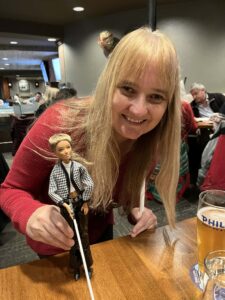
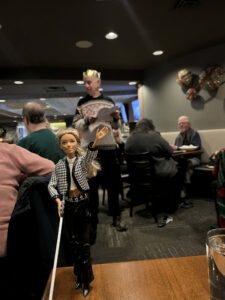
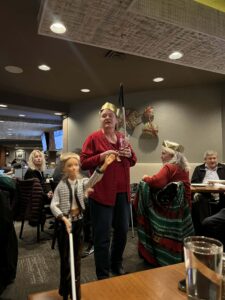
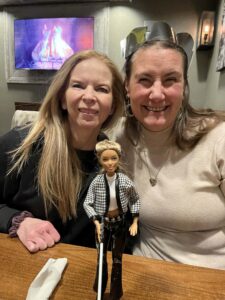
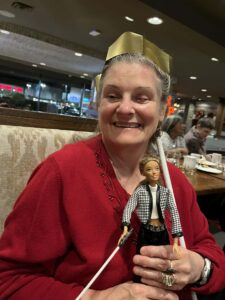
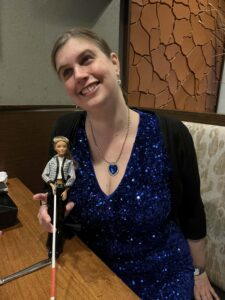
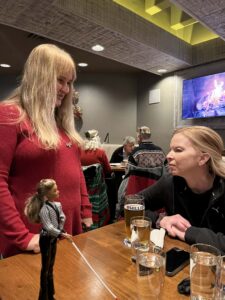
Get Ready! For the 2026 U.S. National Federation of the Blind (NFB) Annual National Convention!

WHEN: July 3 – 8, 2026
WHERE: Austin, Texas. The JW Marriott Austin Hotel will be the primary location and host all convention meetings and seminars, while the Austin Marriott Downtown will serve as our overflow hotel. Both hotels will offer a nightly convention rate of $139 USD per night for singles and doubles and $155 USD for triples and quads, plus a tourism fee and taxes of 19%. You can begin making your hotel reservations on January 1, 2026.
CONVENTION PRE-REGISTRATION: Will open March 1 and close May 31, 2026. Check www.nfb.org for convention detail updates.
The Canadian Federation of the Blind (CFB) strongly encourages blind folk to attend the NFB conventions. They are life-changing experiences for most of us who have attended. It is one of the best learning grounds, organized and run by the blind, for the blind. Here we truly learn that blindness is just one of our characteristics and that we have much potential. We are all mentors and mentees. But it is so great to be around very successful blind role models, whether doctors, lawyers, parents, businesspeople, writers, entrepreneurs, the tech-savvy, educators, leaders and more.
The convention is held annually in a large U.S. city. It is the world’s largest gathering of blind people, often up to 3,000 attendees from around the world. White canes and guide dogs everywhere! At convention, blindness is the norm for a week. There are meetings and seminars and speeches. There is a huge, hands-on exhibit hall with every kind of blindness technology, gadget and so on. The NFB Independence Market sells blindness items. The banquet dinner involves a lovely meal, speeches including the always-anticipated banquet speech, student scholarship presentations, and more. The blind performing arts group often puts on a play during convention. And there’s lots of chances for socializing, for learning, for having fun and being inspired. We gain a new mindset about blindness, capability, confidence and the importance of advocacy, including self-advocacy.
In Memoriam:
Ann Morra Wasserman
June 25, 1940 – January 1, 2026
Photo by Thelma Fayle
Many of us in Victoria knew Ann and will miss our good friend. Ann lived in New Jersey, but came to Victoria annually over 25 years along with her various guide dogs. She loved Victoria. She’d say Victoria felt very accessible – especially the sidewalks, being much more maintained and walkable than those back home. It was through our late, blind friend, Michael Brodsky, that many of us came to know Ann. And while here, she rented and lived in some of our homes.
Ann was fun, had an adventurous spirit and was smart. She had her master’s degree in special education and taught special needs children for many years. In Victoria, she loved swimming, sailing, shopping, reading and spending time with friends. She loved Bubby Rose’s cinnamon buns and Cob’s apricot bread – and Coca Cola!
Our mutual friend, Thelma Fayle, a CFB ally, found this 1985 New York Times online article (below) about Ann. Her Victoria friends did not even know some of her life story, including some of her sporting accomplishments. Please enjoy the read and learn about the life of another fine, blind person who will be much missed.
Blind Skater Aims for the Top
by Jacqueline Shaheen
June 23, 1985, New York Times
To Ann Wasserman of Long Branch, ice skating and skiing have long been two of life’s greatest pleasures. And now Miss Wasserman, who was born legally blind, is training for what is believed will be the world’s first competitive speed-skating event for the blind and visually impaired.
The event will take place at the 1986 Winter Sports Championships of the United States Association for Blind Athletes, tentatively scheduled for Vail, Colo. The dates are to be announced soon.
Oral Miller, coordinator of winter sports for the association, said that, although the blind had speed-skated recreationally, he did not know of any country where they had done so competitively.
The association, a non-profit organization run almost totally by volunteers, decided to include speed skating in its 1986 Winter Games, Mr. Miller said, after a non-competitive trial held at its 1985 Winter Games in Duluth, Minn., demonstrated that such skating was feasible and safe for the blind and visually impaired.
For safety reasons, each athlete will skate individually, and a guidance system appropriate to the degree of vision loss (totally blind, low partial sight, high partial sight) will be used.
The 45-year-old Miss Wasserman, who estimates her vision at about 2 percent, is in the low partial category.
Although Miss Wasserman skated as a child, the demands of schooling forced her to put the sport aside. After graduating from St. Francis College in Loretto, Pa., in 1964, her vision worsened.
Undaunted, she got a job teaching special education in nearby Middletown Township (a position she held until her retirement in 1981), and began working toward a master’s degree, which she received from Columbia University in 1969. She also began to study ice dancing.
Miss Wasserman said she was able to master the intricate ice-dancing patterns because of her instructor’s skill at describing them to her.
When he stopped teaching, Miss Wasserman said, ”I couldn’t find an instructor who could really understand my problem and how to get across to me what he wanted me to do.’’
She still ice-dances frequently, although she no longer takes lessons.
Miss Wasserman also does downhill and cross-country skiing. She competed twice in Norway in cross-country events and placed third at the association’s Winter Sports Championships in Michigan in 1982.
Whether skiing competitively or recreationally, blind people require the assistance of a guide who skis close by and calls out directions.
Miss Wasserman credits her father with encouraging her early to participate in physical activities, despite her handicap. She feels it gave her an advantage that others lacked.
”Many blind children,” she said, ”don’t have the opportunity as young children to really participate in physical activity and, consequently, they don’t develop stamina. By 20 or 30, it’s quite difficult to gain stamina if you haven’t been able to run as a child or if you haven’t moved freely through space.’’
Miss Wasserman remembers a totally blind woman she met while serving as a volunteer in a skating program for the blind. The woman was ”petrified,” she recalled.
”I tried to skate and move with her to get her to relax,” Miss Wasserman said. ”I asked her if she had ever run when she was a child without hanging on to somebody. She said, ‘Oh no, my parents never let me do that.’‘’
Miss Wasserman follows a training regimen that includes speed skating, swimming, bicycle riding, speed walking and calisthenics. Both her coaches have high praise for her.
One coach, Frank Dunn of Fair Haven, admits to having been ”a little amazed” when he was introduced to Miss Wasserman.
”I liked her because she’s got a lot of guts,” he said.
He believes that although Miss Wasserman’s size (she is 4 feet 10 and weighs 90 pounds) will make it difficult for her to successfully compete against bigger, more powerfully built skaters, her strong will and stamina will work in her favor.
Miss Wasserman’s other coach, Frank Spatcher of Lakehurst, thinks she is ”something special.’’
”You can’t believe she’s really blind,” he said.
The Blind Athletes Association would like to send a demonstration team in speed skating to the World Games for the Disabled – they will be held next year in Sweden – with the hope that speed skating will be included as a competitive event in the future.
Miss Wasserman hopes to be a member of that team.
Ann Wasserman – A Large Life in Canada
by Thelma Fayle
Coaches had high praise for the 4’10”, 90 lb woman who trained in speed skating, swimming and speed walking. With the assistance of a guide, Ann took up competitive skiing in Norway. She learned to crew and developed a life-long love of sailing.
After retiring, Ann continued travelling and had her sights on Victoria, BC. She had a feeling it would be a fun town she could manage independently. With less than 2% vision, Ann did not leave things to chance. She memorized the city map.
Every summer for 25 years, she took the long trek to visit an island on the other side of the continent. She rented in different parts of town to check out various neighbourhoods in her beloved Canada, where she heaped up solid friendships.
“Why Victoria?” American friends would ask. “I swim, sail, take the city bus everywhere to enjoy concerts, restaurants, festivals, etc. My guide dog and I can really fly,” she said. She didn’t feel disabled in Victoria; unlike New Jersey, where sidewalks held too many dangerous cracks for a blind walker. “But in Victoria, known for its accessibility, the smooth streets are for everybody,” she marvelled.
Ann wore jewel-tone colours, maintained a great haircut, and was always up on technology. She drank 2 L of coke a day, was fun and had a big New Yorker accent. “Ann made blindness into an art,” said Mary Andrews, one of her many Canadian pals.
At home, Ann belonged to a long-established book club of smart Democrat and Republican senior women. She read 3-4 books a week for 60 years – thanks to an accessible system the Library of Congress offers blind U.S. citizens. She would often call me to suggest nonfiction books. If Ann said “read it”, I usually did – even if the subject was out of my ball park. Recently. it was a book about American privately run prisons. She wondered how I would compare their profit-driven system to Canadian and Norwegian public prisons.
Suddenly, at 72, Ann started to lose her hearing. She feared deafness, coupled with blindness, might end her prized freedom. Determined not to become ‘dependent’ on others, she opted for cochlear implant surgery which restored some hearing. She attended a five-week skills training program for deaf-blind adults at the Helen Keller National Center in New York – and then resumed sailing excursions in Victoria for a few more summers.
In her last year, Ann faced fear when she forgot commands for the braille note-taker she had used forever. “I’m declining,” she announced in our weekly phone call. She wanted another summer in Canada, but knew it couldn’t happen. I reminded her she was well-loved.
As her health diminished, she handed over her last guide dog to her trusted niece. She knew Spring would be happy; and for the first time, she faced life beside a caretaker rather than a cherished guide dog.
Ann died in the comfort of her home, exactly as she hoped.
Thelma Fayle was one of Ann Wasserman’s many Canadian friends.
Recipe!
Whole Wheat Steel Cut Oat Bread
This bread recipe comes to us from our CFB friend, Thelma Fayle. She found it in an old Weight Watchers cookbook, although the recipe has been slightly modified. It is a very good bread and easy to make. So good with butter!
3 c whole wheat flour
1/2 c steel cut oats
2 tsp salt
1 package yeast (or 2 1/4 tsp)
1/2 – 1 tsp sugar
1 1/2 c lukewarm water (use 1/2 c of it for the yeast)
In a cup, proof yeast by mixing 1/2 c lukewarm water, sugar and the yeast. Set aside until foamy.
In a large bowl, mix together flour, oats and salt. Make a well in the center.
Add 1 c warm water and the proofed yeast mixture into the well, stirring with a fork until ingredients are blended. Then knead it in the bowl with your hands until it forms a dough.
Cover bowl and let dough rise in warm place until doubled, about 1 1/2 hours.
Grease a 5×9-inch loaf pan.
Punch down the dough in the bowl, kneading it a bit, then form into a log shape and place into the loaf pan. Loosely cover with a tea towel and let rise for 45 minutes to one hour until dough is doubled.
Meanwhile, preheat oven to 375 degrees.
Bake 40 minutes. Remove bread from pan and cool on wire rack.
It’s very nice spread with butter.
Quotes, Advococy Cartoons and Alphabet in Braille Image
Quote from Winnie the Pooh 🐻
“I am not lost, for I know where I am.
However, where I am may be lost.”
*
The Huge Difference Encouragement Can Make in Ones Life
As Illustrated by a Post on Reddit:
“Lack of sight doesn’t equate to lack of intelligence.”
I was told this by a mentor of mine after being really insecure about my ability to take harder classes in high school.
I had confessed to a school counsellor that I wanted to go to Princeton and study physics and mathematics and she told me that visually impaired / blind people don’t go to schools like that.
I’m starting college this year at a private university in my hometown. I didn’t end up applying to Princeton, but I plan to for grad school. Aiming for a PhD in theoretical physics – all because that one [mentor] teacher reassured me I could.
*
Some Positive Blindness Sayings!
• Get better not bitter.
• Keep your eye on the doughnut, not the hole.
• Courage is being afraid, but saddling up your horse anyway.
• Blindness is not the end of the world, just a pain in the butt.
• If you really want to do something, there is a way. Blind people just do the same task in a different way.
• Try many times, remember when learning a new skill, it takes time.
• The little bird built its nest bit by bit. Rome, too, wasn’t biult in a day.
• Difficulties are opportunities for inner growth.
• You determine your own happiness. Your mental attitude is like a box of crayons – so, colour your picture with bright colours and a sense of humour.
*
Quotes from Stevie Wonder:
“Yes, I am blind. But I am not without vision.”
“What I’m not confused about is the world needing much more love, no hate, no prejudice, no bigotry and more unity, peace and understanding. Period.”
“Law and order comes from having respect for one another.”
“My mother had a rule, obviously, that I couldn’t go across the street by myself, but I had to find a way of doing it.”
*
Quote from Ray Charles:
“Learning to read music in Braille & play by ear
helped me develop a good memory.”
*
Below are Two Advocacy Cartoons With Alt Text
[alt text: 3-frame cartoon image:
1. Blind man with guide dog waits first in line at taxi stand and holds a sign saying ‘taxi’. 2. Taxi arrives and drives away with customers who were not first in line. 3. Blind man remains alone at taxi stand, still holding his sign. The guide dog is thinking, ‘Wow! We must be invisible.’]
Cartoon by Kent Webb
![Cartoon image – man lays in a bike lane near floating bus stop, holding white cane in the air, yelling “help!” The cyclist who hit him rides away.]](https://www.cfb.ca/wp-content/uploads/2021/04/life-threatening-bike-lanes-victoria-bc.jpg)
[Alt Text: Cartoon image – man lays in a bike lane near floating bus stop, holding white cane in the air, yelling “help!” The cyclist who hit him rides away.] Cartoon by Kent Webb
Alphabet in Braille Image
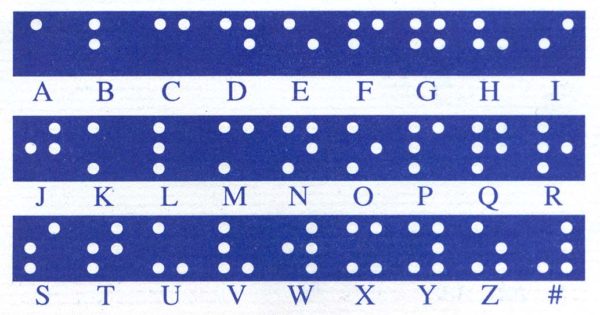
Braille = Literacy